Wordpress.com
Jose Rubio Soto, regional coordinator of the Punta Colonet project, said today that the backers of the mega-port are sharing with the Mexican government’s communications and transportation agency (the SCT) details about existing railroad crossing points between Baja California and the U.S. The objective is to choose one of those for the new rail line that will funnel containers arriving from Asia into Punta Colonet and destined for U.S. cities.
Jose Rubio noted the important time advantage of having Mexico and the U.S. agree to add Punta Colonet rail approval to an exisiting border crossing. The alternative of establishing an entirely new crossing can take eight years to arrange, he and others have noted. Mexicali, Mexico, west of Yuma, is favored by many involved in the development process, according to Jose Rubio. But he noted that more than one rail crossing will likely be required, as import volume grows at Punta Colonet.
www.bajainvestment.com
Mostrando entradas con la etiqueta Mexicali. Mostrar todas las entradas
Mostrando entradas con la etiqueta Mexicali. Mostrar todas las entradas
jueves, 21 de enero de 2010


miércoles, 10 de septiembre de 2008
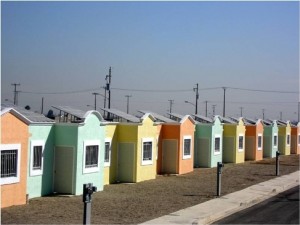
Solar Energy & Energy Efficiency for Baja California Homes
By Keith R | September 9, 2008
This project is interesting to me for several reasons.
I like that it will help home owners reduce their energy consumption, will provide photovoltaics to low- and middle-income households, and will emphasize systems “financially feasible for users” (sometimes household solar systems promoted are not appropriate to the income bracket they are supposed to serve).
I like that the Baja California project is a test case that, if successful, will be duplicated elsewhere in Mexico. [To see why Baja is a good place to start, and where else in Mexico such a project might work well, see my post on LAC solar maps.]
I find it interesting that the project will include work on state-based energy efficiency standards and regulations, something that in the past the Mexican states have left up to the federal authorities. Even more interesting is the reference to setting conditions to attract more renewable energy investments to Baja and the rest of Mexico. I wonder what this will result in? Just favorable conditions on connection and selling to the grid? Or will it also include tax breaks or credits for related equipment, products and services? Stay tuned.
And I’m smiling at the fact that this project is funded by Japanese Trust Fund for Consultancy Services (JCF). My guess is that, because of the source of the funds, the project will have more than Japanese consultants — the products used (photovoltaics, etc.) will likely be sourced from Japan too.
________________________
From the Inter-American Development Bank (IDB):
IDB Supports Renewable Energy and Energy Efficiency for Residential Use in Baja California, Mexico
Pilot project with photovoltaic panels for low- and medium-income sectors
Low- and medium-income households in the Mexican state of Baja California will soon benefit from using photovoltaic panels and other alternative technologies in a pilot project promoting renewable energy and energy efficiency.
This technical cooperation initiative, financed by a US$749,000 donation from the Japanese Trust Fund for Consultancy Services (JCF) at the Inter-American Development Bank, will help selected families in Mexicali—all currently connected to the state’s power grid—reduce their electricity costs.
The financing will support contracting of consulting services and implementation of pilot projects targeting energy efficiency and increased use of alternative energy sources.
Studies will focus on identifying and evaluating projects that are financially feasible for users and can be reproduced in other communities. Another goal will be to establish energy efficiency standards and regulations, as well as conditions for attracting future investments to Baja California and other states in Mexico.
“The idea is to learn from pilot projects on energy efficiency and solar energy resources so that the future will hold more options for supplying sustainable energy at accessible prices,” said IDB project team leader Arnaldo Vieira de Carvalho. “This will also have a positive impact on the environment, because most of the state’s energy currently comes from fossil fuels.”
The project will be executed by the IDB in conjunction with Mexico’s National Energy Savings Commission (CONAE, its initials in Spanish) and the Government of the State of Baja California. It was designed and will be implemented in coordination with the IDB’s Sustainable Energy and Climate Change Initiative (SECCI), whose core objectives are to stimulate greater investments in development of biofuels, renewable energy, energy efficiency, carbon financing and climate change adaptation.
The Japanese Trust Fund for Consultancy Services (JCF) was established by the government of Japan in 1995 and promotes cooperation and knowledge transfer from Japan by utilizing Japanese Consultancy expertise. The JCF has become the largest of the funds established within the technical cooperation funds program managed by the IDB.
________________________
Desde el Banco Interamericano de Desarrollo (BID):
BID apoya Uso Residencial de Energía Renovable y Eficiencia Energética en Baja California, México
Proyecto piloto con paneles fotovoltaicos para sectores de bajos y medianos ingresos
Hogares de medianos y bajos ingresos del estado de Baja California en México se beneficiarán con un proyecto piloto de energía renovable y eficiencia energética, con uso de paneles fotovoltaicos y otras tecnologías alternativas.
La iniciativa de cooperación técnica, financiada con una donación de US$749.000 del Fondo Japonés para Servicios de Consultoría (JCF) en el Banco Interamericano de Desarrollo, ayudará a las familias conectadas a la red eléctrica del estado en Mexicali que sean seleccionadas, a reducir sus gastos de consumo de energía eléctrica.
El financiamiento permitirá la contratación de servicios de consultoría e implementación de proyectos piloto, con el objetivo de aumentar el uso de fuentes alternativas de energía e implementar medidas de eficiencia energética.
Se realizarán estudios destinados a identificar y evaluar proyectos financieramente viables para los usuarios y que puedan reproducirse en otras comunidades. También se buscará establecer normas y regulaciones de eficiencia energética y condiciones para atraer futuras inversiones en Baja California y otros estados mexicanos.
“La idea es aprender de proyectos piloto de eficiencia energética y recursos de energía solar, así en el futuro habrá más opciones disponibles para proporcionar energía sostenible, a precios accesibles para la población,” afirmó el jefe del equipo de proyecto del BID Arnaldo Vieira de Carvalho. “Esto también generará un impacto ambiental positivo, puesto que gran parte de la energía que actualmente se utiliza en el estado proviene del uso de combustibles fósiles.”
El proyecto será ejecutado por el BID con la Comisión Nacional para el Ahorro de Energía – CONAE y el Gobierno del Estado de Baja California. Fue diseñado y será implementado en coordinación con la Iniciativa del BID para Energía Sostenible y Cambio Climático (SECCI, por sus siglas en inglés), que busca estimular mayores inversiones en el desarrollo de biocombustibles, energía renovable, eficiencia energética, financiamiento de carbono y adaptación al cambio climático.
El Fondo Japonés para Servicios de Consultoría (JCF), creado por el gobierno de Japón en 1995, promueve la transferencia de cooperación y conocimiento desde Japón utilizando la experiencia de ese país en el área de consultoría. El JCF se ha convertido en el fondo de mayor tamaño dentro de los programas de fondos de cooperación técnica administrados por el BID.
viernes, 29 de agosto de 2008
The Boys of Winter
Major League Baseball can often be very grueling and get tiresome after a while. Unlike football and basketball, which features a grand total of 98 regular season games combined, pro baseball players must endure through 162 of them. After this season is over, however, some players won't get a chance to catch their breath. Instead of sliding down the slopes of a mountain during their Winter off time, some ballplayers will continue to slide into second base.
Every year, the best athletes with ties to the Greater Antilles participate in a special sporting event known as the Caribbean World Series. It's a big event that attracts thousands of fans, and now for the first time ever scores of Latin athletes will be travelling to Mexicali to showcase their talent.
Political leaders from southern California and southern Arizona are thrilled that the games are going to be played close to home. They're expecting more than 15,000 fans to flock to neighboring cities and are already making the necessary accommodations in anticipation of the big series.
Bob Ingram with the Yuma Visitors Center says he expects about 2,000 rooms to fill up and believes the Desert Southwest's economy will benefit greatly as a result. "I think it'll be very beneficial for restaurants, museums and shopping centers," Ingram said. "It's our opportunity to show off Yuma."
Ingram isn't the only one who thinks that his city will improve economically, city leaders in San Luis and Calexico are projecting big gains as well and, needless to say, they're looking forward to February 2nd when the games officially kick off. In the meantime, however, the waiting game is on as preparations for the big day are still not quite complete.
www.bajainvestment.com
jueves, 28 de agosto de 2008
The Real Story About Baja as Told by American Expatriates
Baja California American and Canadian expatriates become stars of documentary
SAN DIEGO, Aug. 28 /PRNewswire/ -- After months of endless sensational news articles on ongoing and constant rehashing of old stories scaring visitors to stay away, American expatriates living in Baja California said, "Enough."
The Baja California peninsula is home to an estimated 250,000 American expatriates with some 30,000 of them living in Tijuana, Rosarito Beach and Ensenada. Rosarito alone touts over 14,000 American retirees, nearly 10 percent of their 150,000 population.
Melinda Bates, former Social Director for the White House during the eight years of the Clinton Administration, has lived in Rosarito for over three years said, "I read the same news everyone else reads, but I feel perfectly safe here." Mona Keys, originally from Denver who moved to San Diego only to find she couldn't afford to live along the coast so she and her husband moved to Baja Mar in Ensenada said, "My mother calls me from Denver because the news about Baja frightened her, but I tell her not to worry, we're perfectly safe here."
Anne Hines, Canadian expatriate living in Rosarito for 10 year said, "The biggest challenge my fellow expats and I have is allying the fears of our family and friends when they read the headlines and many embellished or just plain untrue stories of the dire consequences for anyone venturing down to Baja."
Many expatriates believe US journalists purposely do not interview them because it would belie the notion that Americans are not safe in Baja.
The expats quickly volunteered to be interviewed for the documentary, The North Baja Coast: Come Visit - Stay to Live, produced by San Diego based TransBorder Communications. The documentary shows the beauty of Baja but the stars are the expatriates who tell their stories on living in Mexico including their personal security, quality and costs of medical services, cost of living and quality of life.
The documentary also highlights each of the four Baja California municipalities: Tijuana, Rosarito Beach, Ensenada, Tecate and Mexicali along with San Felipe, Baja's Palm Springs with a beach.
The half-hour documentary will be shown 50 times from August 25 through September 14 on a number of Time Warner Cable channels in West Los Angeles/San Fernando Valley, Ventura, Orange and Inland Empire counties.
Contact:
Hector C. Molina
TransBorder Communications
http://www.transbordercommunications.com
From your friends at RE/MAX Baja Realty
www.bajainvestment.com
lunes, 18 de agosto de 2008
Baja Peninsula' the Home of Sun, Sea and Sands

Author: Rachelle Fuentes
Baja California, Mexico is simply divine. There are no words to express the free and non crowded beaches, the golden days filled with sunshine and the perfect weather that lasts the year around, cooled by the rich sea-laden breezes. There are just too many activities to do in the Baja peninsula, and appeals to just about everyone. So whether one is looking for a sports adventure or a quite trek through ancient ruins to, Baja peninsula has it all. The variety of water sports is mind boggling, with surfing and kayaking topping the list, along with other activities such as diving, snorkeling, sailing and fishing.
Affordable real estate lures immigrants
The magic of the free and unfettered lifestyle and simple lifestyle appeals to all people and thousands of immigrants flock the shores of Baja California Mexico. The inexpensive housing has sent the Baja California real estate flourishing, with many retirees and migrants seeking to own an apartment, a beach condo or a villa. Many wonderful options are available as the Baja peninsula boasts of beautiful sparsely populated beaches, coves and bays. Convenient oceanfront houses are available, open to the seas and sun, as well as villas and beach homes with all amenities like pool, play courts; club houses etc, in the Baja California real estate options.
There are timeshare options available to vacationers who prefer to share the ownership as they are only present in the vacations. There are about 200,000+ Americans living in Baja peninsula, some of them have jobs and have accepted this land as their home, other continue to hold American passports.
Vacation spots- easy to get there But no vacation in the Baja Peninsula is complete without a visit to Mexicali, the capital of Baja California, about 63 kms from the US border. In spite of its arid desert location Mexicali is watered through a system of aquifers in the valley, which was built to encourage agriculture. Mexicali Baja California now produces grapefruit, dates, vegetables, alfalfa, cotton, and cottonseed oil. Many US companies have set up base in Mexicali Baja California due to the availability of cheap labour.
Mexicali Baja California also relies on tourism and visitors cross by foot or car from Calexico in the United States every day. The welcoming atmosphere of Mexicali Baja California includes delicious food in Mexican restaurants, taco stands, music shows, bars and dance clubs attract tourists to this city. Shops selling Mexican crafts and souvenirs are also located in walking distance from the border.
Another attraction for the young students from many high school and colleges is the low drinking age of 18years in Baja California, Mexico, as opposed to 21 years in the United States.
Rosarito - Where the mountains meet the sea
Rosarito Baja California is another favorite vacation spot as it is conveniently located 20 minutes south of the border from San Diego, California; USA is a perfect weekend getaway. The proximity to the border and stunning location as the coastal foothills greets the Pacific Ocean, makes the Rosarito Beach one of the leading resort towns in Baja California Mexico.
Whatever be the reason, the enchantment of the Baja peninsula lures the tourist with its simple life and natural charisma. The dream vacation is closer than you think, and the way to it is inexpensive, so pack those bags and get moving!
www.remax-baja.com
Suscribirse a:
Entradas (Atom)